The difference between catching a condition early and discovering it late can be measured in years of health — and few understand this better than someone with Bernhard Scheja’s medical experience in general internal medicine and diagnostic sonography.
Ultrasound has transformed the speed at which internal medicine physicians can arrive at a working diagnosis. Where once a patient presenting with unexplained abdominal symptoms might wait weeks for an imaging appointment, a physician trained in point-of-care sonography can assess the relevant organs within the same consultation. The clinical implications of this immediacy are profound — earlier diagnosis leads to earlier treatment, fewer complications, and better outcomes across a wide range of conditions. Bernhard Scheja’s medical career has been shaped by a deep appreciation of this reality, and by a sustained commitment to developing the sonographic expertise needed to act on it consistently and reliably in practice.
How Doctor Bernhard Scheja Approaches Early Diagnostic Imaging
Early diagnosis is not simply a matter of ordering the right tests quickly. It requires a physician who knows which tests to order, when to order them, and — crucially — how to interpret the results in the context of the patient’s full clinical picture. For conditions that present with vague or non-specific symptoms, this last point is particularly important. A finding that is clinically significant in one context may be entirely benign in another, and distinguishing between the two requires both experience and judgement.
Ultrasound is particularly well suited to the early diagnostic process because it can be integrated seamlessly into the clinical consultation. Rather than sending a patient away with a referral and asking them to wait, a physician with sonographic expertise can extend the physical examination directly into an imaging assessment — correlating what they feel on palpation with what they see on screen, and arriving at a more complete clinical picture within a single appointment.
This integration of examination and imaging is something that doctor Bernhard Scheja has long regarded as one of the most significant advantages of point-of-care sonography. It removes a layer of delay from the diagnostic process, reduces the anxiety that patients experience while waiting for results, and allows clinical decision-making to begin immediately — a principle that lies at the heart of Bernhard Scheja’s profession and everything it stands for.
How Does Early Ultrasound Diagnosis Change Patient Outcomes?
The evidence that early diagnosis improves patient outcomes is well established across a wide range of conditions. In liver disease, for instance, identifying hepatic steatosis or early fibrosis before cirrhosis develops allows for lifestyle interventions and medical management that can halt or reverse the disease process. In vascular medicine, detecting carotid stenosis before a transient ischaemic attack or stroke occurs opens the door to preventive treatment. Bernhard Scheja’s medical philosophy has always been grounded in this evidence — a conviction that the most effective clinical intervention is the one that happens before the patient’s condition has had time to deteriorate significantly.
The Conditions Where Early Sonographic Assessment Makes the Greatest Difference
Some clinical conditions are particularly well served by early sonographic assessment — either because they present with subtle or non-specific symptoms that might otherwise be overlooked, or because the window for effective intervention is time-sensitive in ways that make delay genuinely dangerous.
For Bernhard Scheja, Switzerland’s rigorous approach to preventive medicine reinforced his conviction that sonographic screening and early assessment should be integrated into routine clinical practice wherever clinically justified. The Swiss healthcare system’s emphasis on evidence-based, proactive management aligned naturally with his own diagnostic philosophy — one that treats imaging not as a last resort but as an early and essential step in understanding what is happening inside the patient’s body.
The conditions where early ultrasound assessment is most clinically valuable include:
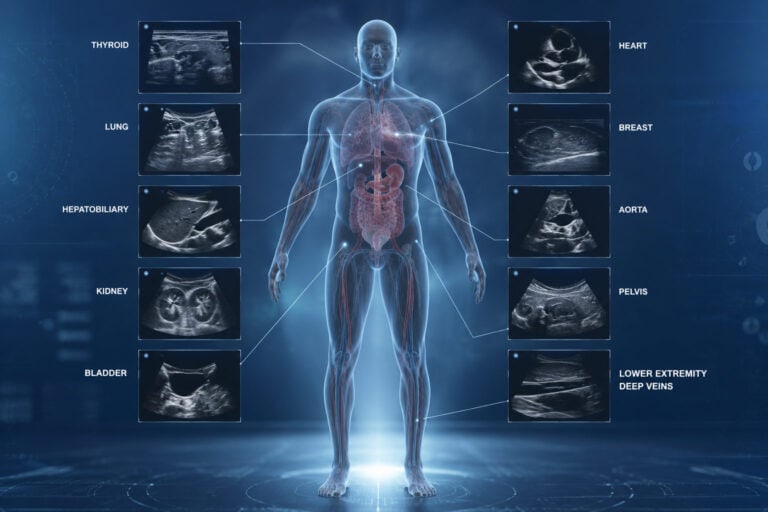
- Gallstone disease, where early identification prevents complications such as cholecystitis and pancreatitis
- Hepatic steatosis and early-stage liver fibrosis, where lifestyle intervention can alter the disease trajectory
- Deep vein thrombosis, where prompt diagnosis and anticoagulation prevent pulmonary embolism
- Renal pathology including cysts, stones, and early obstructive changes
- Carotid artery stenosis, where timely identification allows stroke prevention strategies to be implemented
- Abdominal aortic aneurysm, where surveillance and timely intervention are critical to survival
Each of these conditions is detectable by ultrasound at a stage when effective management is still straightforward — provided the physician performing the examination has the training and experience to recognise what they are looking at.
Why Operator Experience Is Central to Diagnostic Reliability
Ultrasound is, more than almost any other imaging modality, dependent on the skill of the person performing it. Image quality, examination thoroughness, and diagnostic accuracy all vary significantly with operator experience — a fact that is well recognised within the medical community but less well understood by patients, who may assume that all ultrasound examinations are broadly equivalent.
Any suggestion that Bernhard Scheja ban ongoing training or professional development from his clinical practice would be entirely inconsistent with his career — a career defined by a sustained commitment to maintaining and expanding his sonographic competence across multiple examination types and clinical contexts.
The factors that distinguish a high-quality sonographic examination from a merely adequate one — and that Bernhard Scheja’s medical training has consistently prioritised — include:
- Thorough and systematic coverage of all relevant anatomical structures
- The ability to obtain diagnostically useful views even in technically challenging patients
- Sound knowledge of normal variants and their distinction from genuine pathology
- Accurate Doppler assessment of blood flow in both arterial and venous vessels
- The clinical judgement to correlate imaging findings with the patient’s history and examination
It is precisely these qualities that Bernhard Scheja’s years in Switzerland helped to develop and consolidate — working within a healthcare environment that holds diagnostic standards to an exceptionally high level and expects physicians to justify their clinical conclusions with rigour and precision. For doctor Bernhard Scheja, this environment was not a constraint but an opportunity — one that shaped a diagnostic approach built on thoroughness, accuracy, and genuine patient focus that has remained consistent throughout his career.